
Leadership
Decision Rights: The Hidden

Execution often slows for reasons that are easy to misdiagnose. The process may appear sound and the people may be capable. Yet decisions still take longer than they should because no one is completely sure where the authority sits.
When the boundaries are unclear, people naturally seek more input, reassurance, or approval. What appears to be careful collaboration can become a substitute for clear ownership.
At some point, the underlying question has to be answered: who actually has the authority to decide?
Decision rights are one of the least visible parts of an organization’s operating system, yet they have an outsized effect on execution. They shape how confidently people can act, how accountability is distributed, and how much leadership attention is required to keep work moving.
When authority is clear, people can use judgment and move with confidence. When it is not, hesitation and escalation become part of the operating rhythm.
Decision rights are therefore more than a governance issue. They determine how authority moves through the organization and whether accountability is supported by the ability to act.
Decision Friction Is Often an Operating-Model Problem
When decisions take too long, organizations tend to look at the visible symptoms first. They examine meeting cadence, communication, individual performance, or approval processes.
Those may need attention. But recurring decision friction can also indicate that the operating model has not kept pace with the organization.
This often happens as companies grow. Responsibilities expand, new leadership layers are added, and functions become more specialized. Yet the informal rules around decision-making may remain largely unchanged. Managers receive broader responsibility without a corresponding expansion of authority, and cross-functional work increases without anyone revisiting who has the final call when priorities compete.
One COO Forum member saw this around ERP-related decisions. Earlier in the company’s growth, certain system changes routinely came to the COO for sign-off. At the time, that made sense. But as the business scaled, the ERP system improved, responsibilities became more specialized, and other leaders developed the context needed to make many of those decisions themselves. The approval pattern remained anyway. Teams kept routing routine decisions upward because that was how the process had always worked.
The result was a gap between the organization chart and the way authority actually worked.
The problem is that accountability is difficult to sustain when authority has not kept pace with responsibility. A leader may own an outcome on paper while still depending on someone else to approve the decisions that shape it.
Over time, the disconnect can create what might be thought of as decision debt: accumulated ambiguity that makes each new decision harder than it needs to be.
Collaboration Needs a Boundary
The gap between responsibility and authority becomes especially visible in cross-functional work. Modern organizations depend on collaboration, and few important decisions can be made well from a single vantage point.
But collaboration and shared authority are not the same thing.
A decision may require perspectives from several parts of the business without requiring every function to agree before the organization can move. When input and authority are not clearly distinguished, collaboration can drift toward consensus and ownership becomes harder to locate.
A useful question is not simply, “Who should be involved?” It is, “What role does each person play in reaching the decision?”
Some people provide expertise. Others surface risk or operational implications. Some need to understand the outcome because they will be responsible for executing it. One person, however, generally needs the authority to make the call.
At that point, decision clarity becomes a leadership issue rather than a procedural one. Leaders have to create room for input without allowing the desire for alignment to eliminate ownership.
Good collaboration improves judgment. It should not make ownership disappear.
Escalation Can Become a Habit
When ownership remains unclear, the organization usually develops a workaround: escalation. Some decisions genuinely belong at a higher level, but when the boundaries around authority are uncertain, escalation can become less of an exception and more of a default.
Once people learn that senior leaders frequently revisit decisions, intervene after the fact, or expect to be consulted on issues that appear delegated, the organization adapts. Leaders begin escalating earlier because doing so feels safer.
What can look like a lack of initiative may actually be a rational response to the environment leadership has created.
This is why calls for greater “ownership” do not always solve the problem. If employees have learned that authority is conditional, telling them to act more decisively will not change much. Leadership behavior has to reinforce the boundaries around decisions.
A useful diagnostic is to look at what regularly arrives on the COO’s desk.
■ Which decisions genuinely require COO judgment?
■ Which have migrated upward because ownership below is unclear?
■ Which come up because people do not trust that their decision will stand?
The answers can help distinguish an escalation problem from a decision-rights problem.
Put Authority Where the Judgment Lives
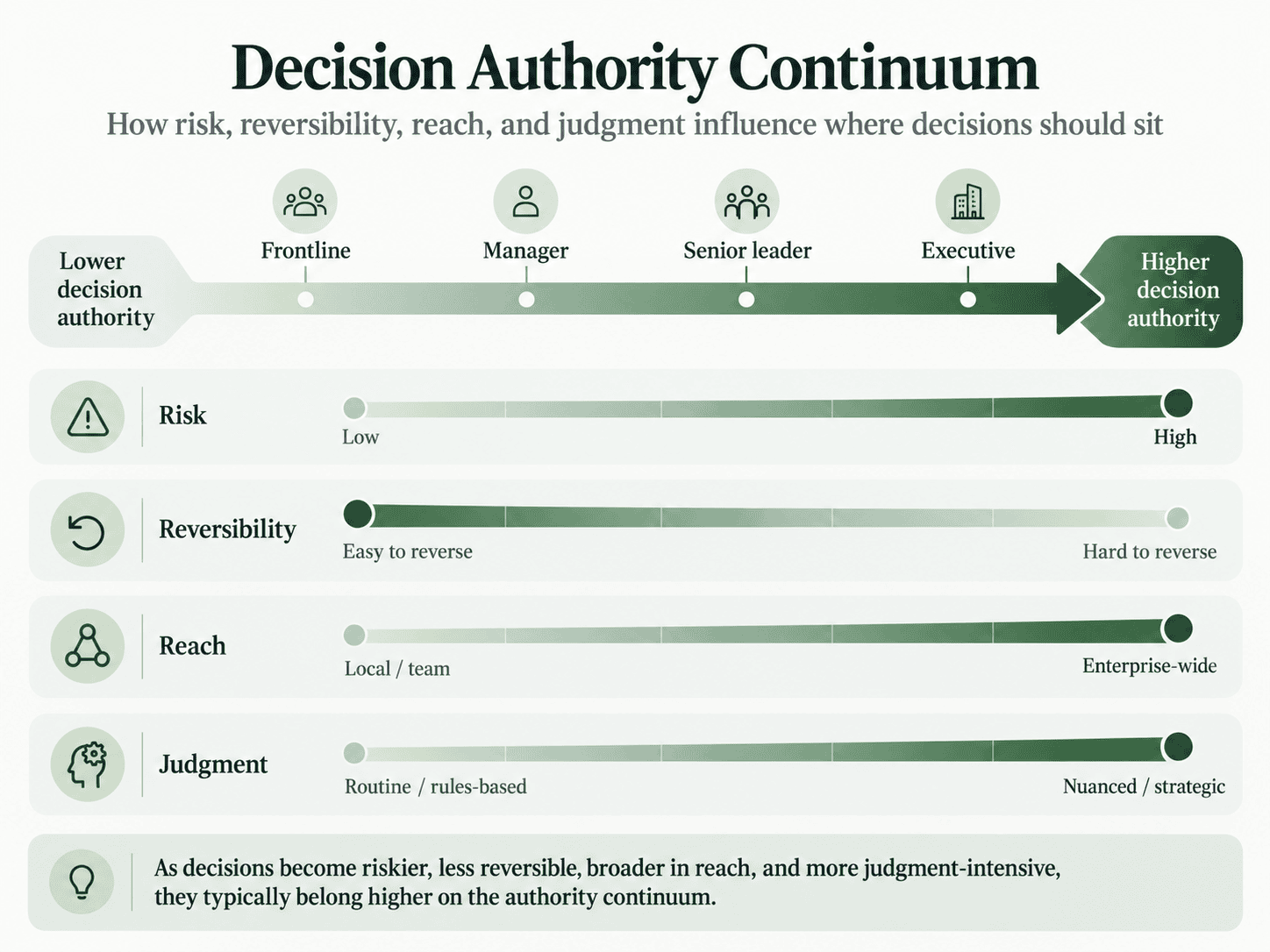
If repeated escalation is the symptom, the next question is where the decision should actually sit. The instinctive answer is often to delegate more, but simply pushing decisions downward can create a different set of problems. The goal is not maximum decentralization. It is better placement of authority.
The right level depends on the nature of the decision. Some choices benefit from being made close to the work, where information is immediate and the consequences are understood in detail. Others require an enterprise perspective because they affect capital, reputation, strategy, or multiple parts of the organization.
Decision placement therefore needs to reflect more than hierarchy. Leaders may need to consider the level of risk involved, how reversible the decision is, how many parts of the business it affects, and where the relevant expertise and context actually sit. A decision with limited downside and a clear path to correction may belong much closer to the work than one whose consequences are difficult to reverse.
The more useful question is: Where does the judgment required for this decision live?
This shifts the focus away from seniority and toward context, expertise, risk, and accountability.
For the COO Forum member, revisiting the ERP approval process made that distinction visible. The leadership team looked at which decisions still genuinely required COO sign-off and which had continued moving upward largely because that was how the process had been designed when the company was smaller. Many of the routine approvals could now be handled by leaders closer to the system, while clear thresholds identified the situations that still warranted executive involvement.
The revised approach did not eliminate oversight. It brought the decision structure in line with the organization the company had become. As systems, roles, and leadership capability had matured, the decision matrix needed to mature with them.
This is an important consideration as organizations scale. Processes and technology may evolve while approval habits remain unchanged. If decision points are not periodically revisited, senior leaders can remain embedded in work that no longer requires their judgment simply because no one has questioned the original design.
Real empowerment is not the absence of oversight. It is clarity about where judgment belongs, what can be decided independently, and when escalation still adds value.
The CEO–COO Relationship Sets the Ceiling
Decision rights become even more consequential at the top of the organization, where ambiguity can influence how authority is interpreted throughout the business.
If the CEO and COO have not clearly established where independent authority begins and ends, other leaders are left to interpret that relationship themselves.
The effects can be subtle. Leaders bypass the COO on certain issues. Decisions already made are checked with the CEO. The COO hesitates to act because expectations around consultation are unclear. The CEO believes authority has been delegated while the COO believes the final decision still sits above.
The problem is not necessarily a lack of trust. Often, it is a lack of specificity.
CEO–COO alignment therefore requires more than agreement on strategy and priorities. It also requires clarity around where each leader has independent authority, where consultation adds value, and what circumstances require escalation.
When those boundaries are clear, the organization receives a much stronger signal about how authority should work. If decision rights are ambiguous at the top, it is difficult to expect them to be clear below.
Decision Rights Shape Leadership Capacity
Decision ambiguity has another cost that is easy to overlook: it changes where senior leaders spend their attention.
Every decision that rises unnecessarily to senior leadership takes attention away from work that genuinely requires an enterprise perspective. Over time, executives can become the organization’s decision bottleneck without realizing it.
The cost is not just slower execution below them. It is reduced strategic capacity above them.
A COO spending significant time adjudicating routine questions has less time to examine emerging risks, strengthen the operating model, build leadership capability, or work with the CEO on what comes next.
Decision rights, then, are ultimately about more than speed. They help determine whether leaders are spending their attention at the level where it creates the most value.
Organizations do not need perfect clarity around every possible decision. That would create its own bureaucracy. But recurring decisions, high-friction decisions, and decisions that consistently rise higher than expected deserve closer examination.
A useful place to begin is with the decisions that repeatedly consume more organizational energy than they should.
Ask:
■ Who believes they own this decision?
■ Who actually has the authority to make it?
■ What would require escalation?
■ What happens after the decision is made?
The answers may reveal that an execution problem is really an authority problem.
As organizations grow, the decisions themselves change, but so should the way authority is distributed. Periodically revisiting where decisions sit can prevent yesterday’s approval structure from becoming tomorrow’s bottleneck.
Clear decision rights do not eliminate debate, collaboration, or thoughtful escalation. They give each one a boundary – and help the decision structure evolve with the business.

Shawneen Orzechowski
Shawneen Orzechowski is Co-owner and Head of Outreach at COO Forum, where she works closely with Chief Operating Officers and senior operations executives across the country. Her work includes researching and writing about the issues shaping modern operations leadership, developing executive resources, and translating insights from COO Forum members, presenters, and industry research into practical content for operations leaders. She is also a former educator and published author.
COO Forum Peer Membership