Leadership
Leading When the Team is

A practical guide for COOs navigating high-pressure moments
Every operations executive eventually faces the moment when their team is running on fumes. The signs vary - missed handoffs, rising tension, slower decision-making, confusion over priorities - but the story underneath is the same: capacity is tapped, clarity is slipping, and the business is feeling it.
What matters most in these moments isn’t heroic effort. It’s how leaders create stability, restore focus, and help people breathe again without losing momentum.
Why Teams Get “Stuck”
Pressure doesn’t automatically reveal weakness. It often reveals friction. When teams feel stretched, they’re usually battling competing priorities, evolving expectations, or unspoken assumptions about who owns what. Stress magnifies these gaps. People start conserving energy, protecting their bandwidth, and second-guessing decisions.
Productivity drops, not because the team doesn’t care, but because the environment is asking for more than the system can support.
Strong COOs treat these moments less like crises and more like diagnostics. The goal isn’t to push harder; it’s to understand what’s constraining performance and remove it.
First: Create Stability Before You Create Speed
When stress is high, speed is overrated. Teams don’t need more urgency; they need more certainty. Leaders can help by anchoring the environment around a few fundamentals:
Establish clear priorities that don’t shift every week.
Set realistic expectations for what “good” looks like right now.
Create a communication cadence that feels predictable, not reactive.
This doesn’t slow the business down. It reduces the noise that keeps people stuck.
Second: Help the Team Make Sense of What’s Happening
When people are overwhelmed, they often lose context. They see tasks, not purpose. They see demands, not signals. The COO’s role is to reconnect the dots and translate complexity into something people can navigate.
This can sound like:
“Here’s what matters most over the next two weeks, here’s why, and here’s how we’ll know we’re making real progress.”
Context builds confidence. When people understand the “why,” their capacity expands - even when workloads don’t shrink.
Third: Shift From Problem-Solving to Pattern-Spotting
In high-pressure moments, leaders feel pulled into firefighting. The challenge is resisting the instinct to jump into every problem. Instead, step back and look for the pattern behind the issues.
Is the team stuck because:
Work is bottlenecked behind a single decision-maker?
Priorities conflict across departments?
People lack visibility into what others are shipping?
Processes are outdated for the pace the business now operates?
Patterns tell you where leverage is. Addressing the root creates relief far faster than answering the tenth Slack message of the morning.
What Strong Leadership Looks Like Under Sustained Pressure
Once stability and clarity are in place, leadership shifts from diagnosis to reinforcement. Stress compresses thinking, turning teams task-driven rather than solution-driven. COOs can counter this by creating space, however small, for people to think, make sense of complexity, and regain agency.
That might mean short working sessions focused on decision-making and problem framing rather than output. Even 20 minutes spent clarifying a messy situation together can reduce anxiety, increase ownership, and unlock forward motion.
During these periods, teams watch leaders closely. They’re not looking for perfection; they’re looking for steadiness. A COO who acknowledges strain (“We’re at capacity, and that’s real”) while staying solutions-focused (“Here’s how we’re moving through it”) signals psychological safety. When people feel seen, they don’t shut down. They step up.
Momentum matters here. When teams feel stuck, confidence erodes and big goals feel distant. Small, credible wins - tighter handoffs, a clarified process, an obstacle removed - restore movement. Momentum isn’t motivational fluff; it’s the foundation of resilience.
COOs also need to be careful not to become the new bottleneck. Acting as a buffer is important, but absorbing everything creates dependency and strain. Selective buffering, filtering noise while keeping teams connected to reality, protects capacity without disconnecting people from the business.
The Bottom Line
Leading a stressed or stretched team isn’t about being the hero. It’s about being the stabilizer. The leader who brings clarity when everything feels noisy. The one who reduces friction when energy is running low. The one who helps people see a path forward when the workload feels bigger than the bandwidth.
COOs don’t eliminate stress. They help teams move through it with more confidence, more alignment, and fewer avoidable obstacles. And in doing so, they build organizations that are better equipped for whatever stretch comes next.
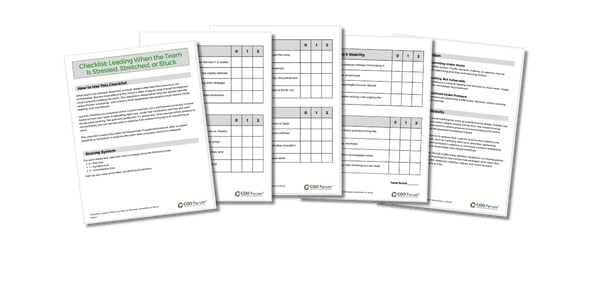
Checklist: Leading When the Team is Stressed, Stretched, or Stuck