AI
Task Deconstruction: The COO's Tool For
Designing Hybrid AI–Human Workflows

Breaking work into components to identify where AI accelerates, where humans decide, and where the system needs redesign.
AI is changing how work gets done, but most organizations still approach implementation at the wrong altitude. They start with entire roles (“What can AI do for a customer service rep?”) or full processes (“How can we automate onboarding?”). The problem is that roles and processes are too big, too blended, and too dependent on human judgment to automate cleanly.
COOs know that the real leverage comes from understanding work at the task level. That’s where the distinctions between automation, augmentation, and human decision-making become clear - and where AI can be applied with intention rather than disruption.
Task deconstruction is the discipline of breaking work into its smallest functional components so you can redesign workflows around the right combination of AI and human capability. Instead of asking, “What can AI automate?” the question becomes, “Which elements of this work require judgment, empathy, pattern recognition, or context - and which elements don’t?”
We recently spoke to Jill Tarallo, Chief Operating & AI Transformation Officer at Rollick, Inc., and she recommends that every decomposed task should be classified by autonomy level (AI-Assisted, AI-Recommended, or AI-Executed) and then mapped to an appropriate risk tier to determine required human oversight.
· AI-Assisted: AI supports human decision-making; humans retain full control and accountability.
· AI-Recommended: AI provides recommendations that must be reviewed and explicitly approved by a human before action.
· AI-Executed: AI systems perform actions autonomously. These are limited, tightly controlled, and require explicit approval before implementation. AI-Executed workflows must include defined validation windows (e.g., 30–90 days) during which human oversight and audit sampling remain mandatory before full autonomy is granted.
Organizations new to these concepts should resist the temptation to move directly to AI-Executed workflows. A progressive autonomy model, beginning with AI-Assisted, then AI-Recommended, and later AI-Executed with audit controls, allows risk to be managed while capability scales.
AI activities/use cases can be classified into one of the following risk tiers (each organization will be different, and as such, this is simply an example provided for reference). She further recommends that your governance policy should clearly define the human accountability layer based on risk:
· Low Risk: Internal productivity tools with no sensitive data, no automation, and no external impact.
· Medium Risk: AI-enabled workflows, internal automation, or decision support involving internal or confidential data.
· High Risk: Customer-facing AI, autonomous agents, AI accessing restricted data, or systems capable of taking action without direct human initiation.
Regardless of risk tier, Jill suggests hybrid workflows must include logging, monitoring, and defined escalation thresholds to ensure AI behavior remains within approved boundaries. For example, in financial redemption workflows, AI may validate submission data and flag anomalies, but final approval remains human-controlled until performance thresholds are consistently met.
This shift moves organizations away from treating jobs as monoliths and toward viewing them as collections of microtasks that can be redistributed, reconfigured, or reimagined. When COOs take this lens, hybrid workflows stop being theoretical and start becoming operable.
What Work Really Looks Like When You Break It Down
When workflows are dissected, work typically reveals itself as a combination of retrieval, interpretation, decision-making, execution, exception handling, and coordination. Traditional workflows blur these elements together, which is why attempts to “automate the whole thing” often fail.
Once these components are separated, it becomes much clearer where AI accelerates speed and consistency, where humans anchor judgment and alignment, and where the system itself needs redesign to support both.
For example, what looks like a single task such as “prepare monthly operational analysis”, might actually contain a dozen microtasks: consolidating data, cleaning anomalies, contextualizing trends, aligning with strategic priorities, drafting commentary, anticipating leadership questions, and coordinating with cross-functional partners.
AI excels at the early, pattern-based work. Humans are essential where judgment, synthesis, and communication come into play. Task deconstruction can turn this realization into a repeatable operating mechanism.
Task deconstruction also surfaces what organizations tend to overlook. Many tasks that appear simple rely heavily on institutional memory, informal decision rules, or tacit knowledge - elements AI cannot replicate without system redesign. At the same time, tasks assumed to be complex are often largely pattern-based and ideal for AI acceleration once inputs are stabilized. Jill stresses that the real value isn’t in layering AI onto a legacy workflow; rather, it’s in rethinking and redesigning the entire system so AI and humans are intentionally orchestrated to eliminate friction, reduce risk, and unlock new levels of speed, scale, and judgment.
By revealing these nuances, task deconstruction prevents organizations from over-automating the wrong areas while missing opportunities in the right ones.
Redesigning the System, Not Just Inserting AI
The psychological impact of this approach matters as much as the technical one. When AI is framed as replacing tasks rather than replacing people, teams feel safer experimenting. The narrative shifts from displacement to redistribution: letting AI handle the repetitive elements so humans can focus on judgment, expertise, and creative problem-solving.
Most importantly, task deconstruction allows COOs to redesign the system itself. Once tasks are broken down, leaders can intentionally answer three questions:
What should AI reliably handle every time?
Where must a human intervene for judgment, nuance, or alignment?
What needs to change upstream or downstream to make this hybrid workflow stable?
The result is cleaner handoffs, clearer expectations, and a more resilient operating model - one where human capability is elevated, AI capability is standardized, and the organization moves faster with greater confidence.
In the AI era, the COO’s value is not just adopting new tools. It is redesigning how work happens so humans and AI each do what they do best. Design AI systems where humans retain judgment authority over financial, reputational, and ethical impact while automation handles repetition and scale. Task deconstruction is the method that makes that possible - turning complexity into clarity and experimentation into operational strength.
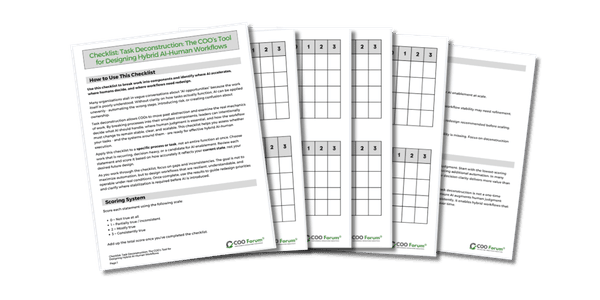
Checklist:
Task Deconstruction: The COO's Tool For
Designing Hybrid AI–Human Workflows