Leadership
The Gap Between Planning

For many leadership teams, the final months of the year are spent looking ahead.
Strategic priorities are taking shape. Budgets are being finalized. New systems, processes, initiatives, and organizational goals are being mapped onto the year ahead.
Each decision may make sense on its own. But before those plans become next year's organizational reality, there is another question worth asking: What are we asking people to absorb?
Leadership teams can spend months planning change. They evaluate options, debate tradeoffs, assess risks, revisit decisions, and gradually become accustomed to what the organization will do next. By the time a new initiative is announced, leaders may have been living with the idea for weeks or even months.
Employees may have been living with it for five minutes.
That difference matters.
When people question a new system, process, policy, or organizational priority, leaders can be quick to interpret the reaction as resistance. But before getting there, I want to understand something else: What don't people know yet?
Sometimes the issue is uncertainty. Sometimes employees simply haven't had enough time to process what leadership has been discussing behind closed doors. Sometimes the organization is asking people to absorb too many changes at once. And sometimes people understand the change perfectly well and have legitimate concerns about it.
Those are different operating signals. Good change leadership requires knowing the difference.
Leaders Have a Head Start on Change
The executive team understands the business case and the problem the initiative is intended to solve. They may have reviewed budgets, considered alternatives, challenged assumptions, and discussed implementation scenarios.
They've also had something employees haven't: time to adjust.
When the announcement comes, employees are beginning a process that leadership may have largely completed. Their questions may simply be an effort to understand what the decision means for them.
A Successful Implementation Isn't the Same as Successful Adoption
I've seen this become particularly visible during technology implementations.
IT teams have an enormous responsibility. They select and maintain platforms, manage integrations and security, troubleshoot problems, and make sure the technology works. They can execute all of that extremely well without necessarily being the people best positioned to explain why employees are being asked to change their behavior.
When no one owns the responsibility for explaining the why behind the change, the symptoms show up quickly.
Employees create workarounds. Some continue using the old process. Support questions increase. Managers become the first place employees turn for answers, but they may not have been given enough information themselves. Now they're frustrated too because they don't know what to tell their teams or where to get answers.
The technology may have been successfully deployed.
The organization wasn't necessarily prepared to use it.
I've also experienced the opposite.
During a travel management company transition, we started by listening. We surveyed employees about their pain points and what an improved experience would look like, then used small working groups and pilots before the broader rollout.
Communication continued throughout the process. Employees in the working groups and pilots were encouraged to share what they were seeing and learning with colleagues.
Training wasn't a single meeting on the calendar. Employees had multiple opportunities to attend in different formats, days, and times, with a designated point of contact for additional training and questions.
None of those actions is particularly revolutionary.
Together, they made the change something employees could prepare for rather than something that simply happened to them.
Communication Is Not the Same as Readiness
Organizations sometimes treat communication as evidence that people have been prepared for a change.
The email was sent. The town hall was held. The training was provided. People should be ready.
But knowing something is happening and being ready to work differently are not the same thing.
Prosci's ADKAR model provides a useful way to think about that progression:
• Awareness of the need for change
• Desire to participate and support the change
• Knowledge on how to change
• Ability to implement required skills and behaviors
•Reinforcement to sustain the change
An announcement can create awareness. It cannot, by itself, do the rest.
For COOs, the objective isn't simply to communicate a decision. It's to create the conditions in which the organization can absorb and sustain it.
Diagnose the Uncertainty
When a change initiative begins generating pushback, there are six areas I pay attention to before concluding that the problem is resistance.
•Timeline. When will this happen, and what should people expect along the way?
• Goals and objectives. What will actually be different when this is finished? What outcome is the organization trying to create?
•Impact. What changes for employees, their teams, or the way they work?
•Expectations. What are people being asked to do differently, and when?
•Support. Where can employees go for training, resources, questions, and help as they learn a different way of working?
•Voice and input. Where can people raise concerns or offer feedback, and do they believe anyone will actually listen?
Creating a channel for feedback doesn't mean leadership can or should incorporate every suggestion. Organizational constraints may prevent leaders from taking the path employees would prefer. They can still acknowledge what they heard, explain what can and cannot change, and be clear about why. Listening isn't the same as handing over the decision.
Sometimes the Concern Is Legitimate
AI adoption is a good example.
Organizations are determining how to introduce AI while employees raise legitimate questions about ethical use, environmental impact, governance, and the changing nature of work.
Those questions shouldn't be dismissed as resistance simply because leadership believes AI adoption is necessary.
At the same time, organizations have a responsibility to prepare employees for a workplace increasingly shaped by AI and to develop the skills they will need to work effectively with others already using these tools.
Both things can be true: the organization can have compelling reasons to move forward, and employees can have compelling reasons to question how it moves forward.
The goal isn't to communicate until the questions disappear. It's to distinguish questions caused by missing information from concerns that deserve genuine consideration.
Change Has a Capacity Problem Too
There is another question leadership teams should ask before announcing the next initiative: What else are we already asking the organization to absorb?
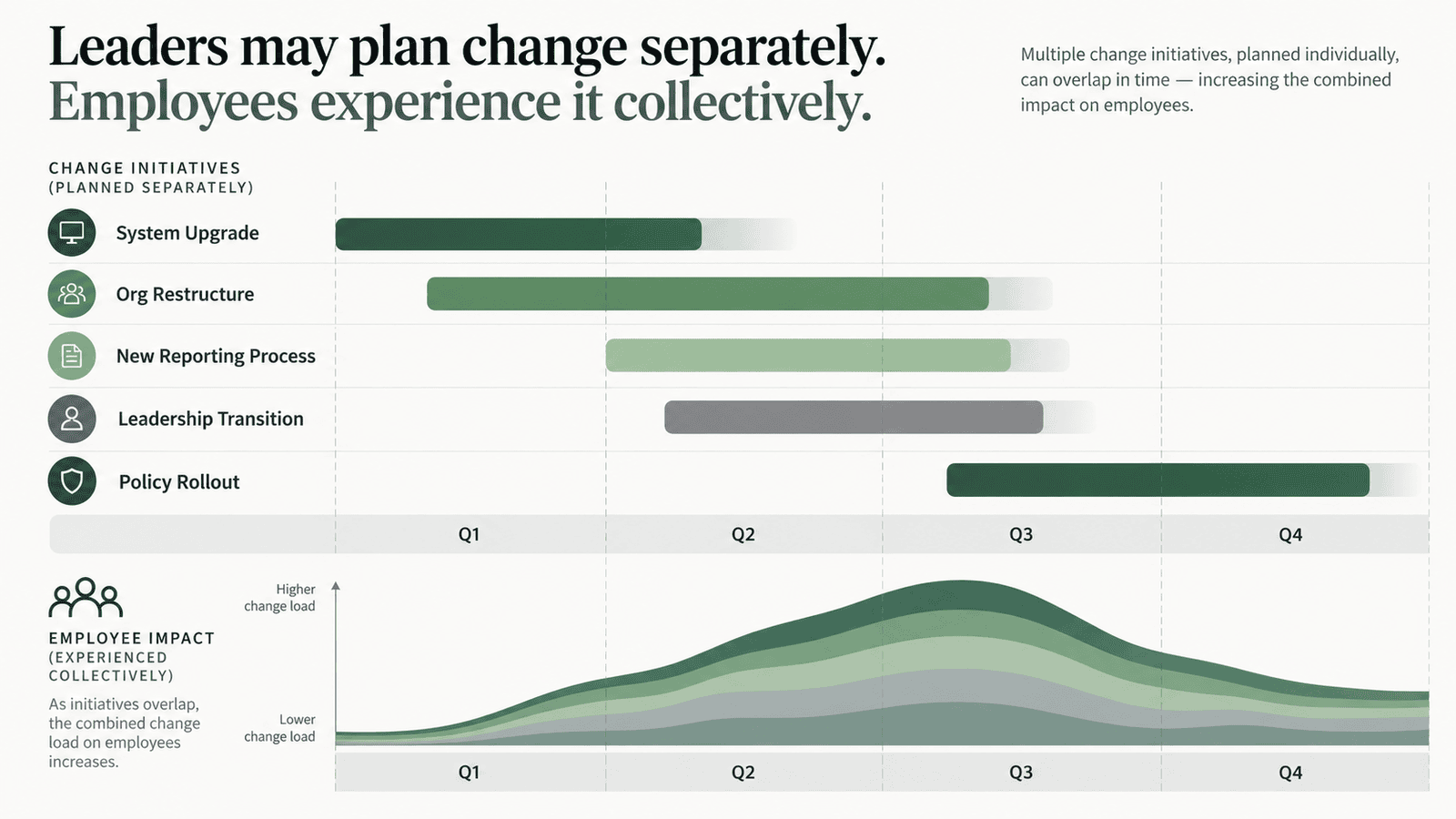
Organizations tend to plan change initiative by initiative. Employees experience it collectively.
Project plans help us determine whether an initiative can be delivered: the timeline, resources, dependencies, milestones, and risks. But a project can be executable on paper without the organization being ready to absorb it.
Put them onto one organizational timeline and the picture can look very different.
A new invoice-management system might have a perfectly reasonable implementation schedule. But rolling it out during audit season may place additional demands on exactly the people with the least capacity to absorb them. Asking HR to lead a major staff initiative during open enrollment creates a similar collision.
And not every demand for organizational capacity appears on a project plan. Political uncertainty, market volatility, funding pressures, or events affecting the communities an organization serves can all change how much capacity people have available.
So, the question isn't simply: Can we complete all of these projects?
It's also: Can the organization absorb all of this change?
That's a different question, and one COOs are particularly well positioned to ask.
Give the Changes a Common North Star
Looking across the full portfolio also allows leadership to ask whether the changes make sense together.
If we're asking employees to absorb several changes, they shouldn't feel like a random collection of demands. Leaders need to connect them to something larger: the organization's mission, values, vision, and responsibility to its staff.
Why are we making these changes?
• How do they move the organization forward?
• How do they remain consistent with who we say we are?
• And what do we owe our people as we ask them to change with us?
A cohesive "why" doesn't guarantee agreement. But employees should be able to understand how leadership arrived at a decision, where the organization is going, and how the changes support that direction.
Pushback Is Data
The COO often sits at the intersection between the strategy leadership develops and the reality employees experience when that strategy reaches their day-to-day work.
That creates an important responsibility during change.
COOs can help leadership see the cumulative change load before initiatives collide. They can identify when no one owns the people side of an implementation. They can make sure managers have what they need before employees begin turning to them for answers. They can connect individual initiatives to a larger organizational direction and make sure concerns have somewhere to go.
So, when employees push back, perhaps the first question shouldn't be: How do we get them on board?
It should be: What is this reaction telling us?
Maybe people need information. Maybe they need time or support. Maybe the organization has exceeded its capacity for simultaneous change.
Or maybe they see something leadership doesn't.
The goal of change leadership isn't to eliminate concern or manufacture buy-in. It's to remove avoidable uncertainty so leaders can hear the concerns that actually matter.
As leadership teams plan what's next, the question isn't only whether each initiative makes sense or can be successfully executed. It's whether the organization can absorb the changes collectively. Before adding the next initiative to the plan, it's worth returning to a deceptively simple question: What are we asking people to absorb?

COO Forum Peer Membership