COO ROLE
Balancing Strategic Work With
Operational Pressure
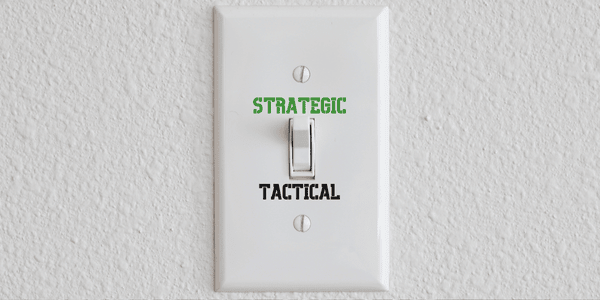
COOs operate at the fault line between execution and evolution. On one side is the daily operational engine -customer delivery, cross-functional coordination, system reliability, workforce management, and organizational rhythm. On the other is the long-term work that determines whether the organization will still be competitive tomorrow - capacity planning, operational maturity, AI integration, scaling readiness, and transformation.
Both are non-negotiable. But in 2025, operational pressure is heavier than ever. According to the COO Forum State of Operations Report, COOs can no longer focus solely on running today’s business; they are now carrying responsibility for AI strategy, change leadership, and scaling in volatile economic conditions, all while labor costs rise and uncertainty persists.
When systems strain, teams escalate, and external forces shift, the pull of execution becomes relentless.
Without a deliberate approach, strategic work doesn’t get deprioritized once. It gets slowly erased. The organization stays busy, but progress stalls. Efficiency improves in the short term while long-term resilience quietly erodes.
This was a central theme throughout my early career as an operations leader. I knew that I needed to spend more time on the strategic work but the tactical, day-to-day operations would usually win out. And, I became so good at quickly handling pressure situations, fast thinking, and deciding on the fly that, in some ways, I was self-sabotaging my ability to concentrate long enough to think strategically. Something had to give.
The COO’s challenge is not choosing between strategy and operations. It is designing an operating model where both can coexist under pressure. This balance is not achieved by longer hours or heroic multitasking. It is achieved through clarity, system design, disciplined prioritization, and the ability to periodically rise above the noise. (My lightbulb moment.)
COOs who get this right become force multipliers. Strategy survives pressure and operations improve because strategy is guiding them.
Why Operational Pressure Always Wins Without Intervention
Operational issues are immediate, visible, and emotionally charged. Strategic work - especially AI road-mapping, change readiness, and future-state design - is abstract, long-term, and easy to delay. The State of Operations data reinforces this reality: COOs cite AI implementation, change leadership, and scaling as top challenges precisely because they compete with daily execution for attention.
Organizations unintentionally amplify this imbalance through constant escalations, shifting priorities, and unclear decision rights. In that environment, urgency beats importance every time - unless the COO intervenes by design.
Treating Strategy as a System, Not a Side Project
Many COOs try to “protect time” for strategy. Time helps, but it’s not enough. Time blocking is a typical tool for saving time for strategic thinking. However, strategic progress requires infrastructure: clearly defined priorities, milestones tied to operating rhythms, and cross-functional reinforcement. The organizations that navigate complexity best are those that embed strategy into cadence - monthly reviews, leadership forums, and measurable outcomes.
When strategy is treated as a system, it stops slipping. When it’s treated as spare-time thinking, it never sticks.
Diagnosing the Real Sources of Operational Pressure
Not all operational pressure is inevitable. Some is structural. Some is self-inflicted, like mine. COOs often discover that their workload is inflated by unclear ownership, weak handoffs, over-escalation, or leaders who lack confidence to decide independently. Reducing pressure starts with diagnosis - not by pushing harder, but by fixing the system creating the noise.
Strategy only becomes real when constraints exist. What matters most this year? What will wait? What trade-offs are acceptable? What capacity must be preserved for AI adoption, workforce development, or scaling readiness?
The strongest COOs use constraints to protect focus. They say “not now” without apology. Without constraints, everything feels urgent - and strategy never stands a chance.
Elevating Out of the Noise
COOs must periodically step above execution to identify patterns, anticipate friction, and guide direction. The State of Operations Report makes this clear: leaders who stay trapped in day-to-day problem solving struggle to lead transformation, especially in AI and change-heavy environments
Strategic clarity requires altitude. Operational excellence requires depth. Effective COOs deliberately toggle between both.
No COO can carry operations and strategy alone - especially now. High-performing organizations invest in leaders who can absorb operational complexity, own outcomes, and escalate with judgment. When leadership teams are capable and aligned, noise decreases and strategic capacity expands. This shift from doing the work to leading the system that does the work is the dividing line between burnout and scalability.
The Bottom Line
Balancing strategic work with operational pressure is not a time-management problem. It is a design problem. In 2025’s environment of AI acceleration, economic uncertainty, and constant change, COOs who intentionally structure how work flows, how decisions are made, and how priorities are reinforced create space for strategy even under pressure.
The organization becomes stronger. The future becomes clearer. And the COO becomes what the role increasingly demands: a stabilizing force who can manage today while actively building tomorrow.
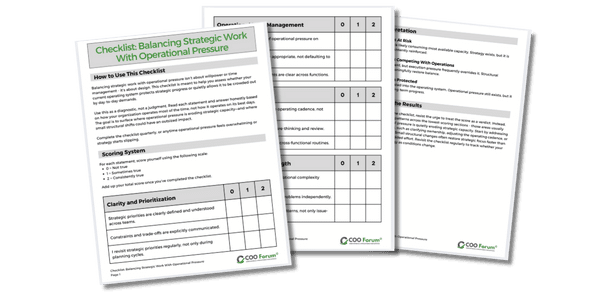
Checklist: Balancing Strategic Work With Operational Pressure